
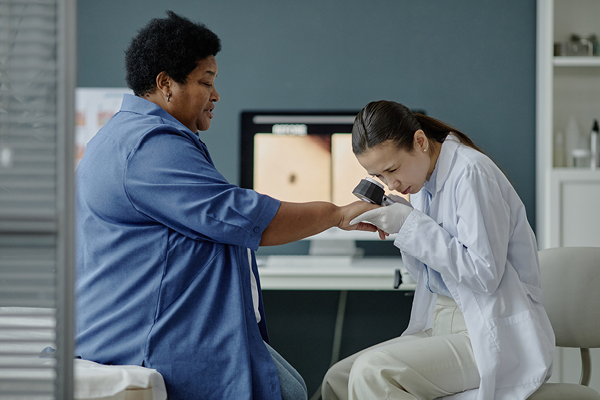
When was the last time you really checked your skin? Many people know to watch for a suspicious mole or a changing freckle, but skin cancer doesn’t look the same on everyone. Its appearance can vary a lot depending on your skin tone.
Since most skin cancer awareness focuses on lighter skin, people with medium or darker skin might miss the warning signs. Knowing what to look for can make a big difference.
Skin cancer is the most common cancer in the United States and can affect people of all backgrounds. Although lighter skin carries a higher risk overall, people with darker skin are less likely to catch it early. That’s why education and awareness are so important for everyone. The earlier skin cancer is found, the more treatment options there are and the better the chances of a good outcome.
On lighter skin, signs are usually easier to see. Basal cell carcinoma, a common skin cancer, might look like a pearly or pink bump, a flat flesh-colored patch, or a spot that resembles a scar. Squamous cell carcinoma can appear as a firm red bump, a rough scaly patch, or a sore that heals slowly. Melanoma, the most aggressive type, is often spotted using the ABCDE rule: asymmetry, irregular borders, multiple colors, a diameter bigger than a pencil eraser, and any spot that changes over time. On fair skin, melanoma often shows up as a dark brown or multicolored mole with uneven edges.
On medium skin tones, these conditions can look quite different and might be mistaken for other skin problems. Basal cell carcinoma may appear as a shiny, colorless bump or as a small sore that heals but then reopens. Squamous cell carcinoma can appear in places that don’t get much sun, like the legs, groin, or feet, and might look like a wart, a dark patch, or an ulcer. Because the difference between the spot and your skin can be subtle, it’s easy to miss. We encourage everyone to trust their instincts. If something looks or feels unusual, it’s always a good idea to get it checked.
On darker skin tones, skin cancer is often diagnosed at a later stage simply because it can be harder to spot. Melanoma in people with deeper complexions tends to develop in areas that rarely see the sun, including the palms of the hands, the soles of the feet, under the nails, and even inside the mouth. This type may show up as a dark streak beneath a nail, a growing spot on the palm or sole, or a gradually expanding discolored patch. Because these areas aren’t typically associated with sun damage, the connection to skin cancer isn’t always made right away. Knowing this can make all the difference in catching it sooner.
No matter your skin tone, one of the best things you can do is check your skin regularly. Spend a few minutes each month looking over your whole body, including spots that don’t get much sun. Our team is always here to answer your questions and help you feel confident about what to watch for.
Getting an annual skin check with a specialist is especially important if you have a personal or family history of skin cancer, a lot of sun exposure, or if you notice any of the changes we’ve described. Our team is committed to giving personalized, caring support so every patient feels looked after from their first visit. Early detection means more treatment options and better results, and we’re proud to support our patients every step of the way.
published: March 30, 2026, 6:37 p.m.